
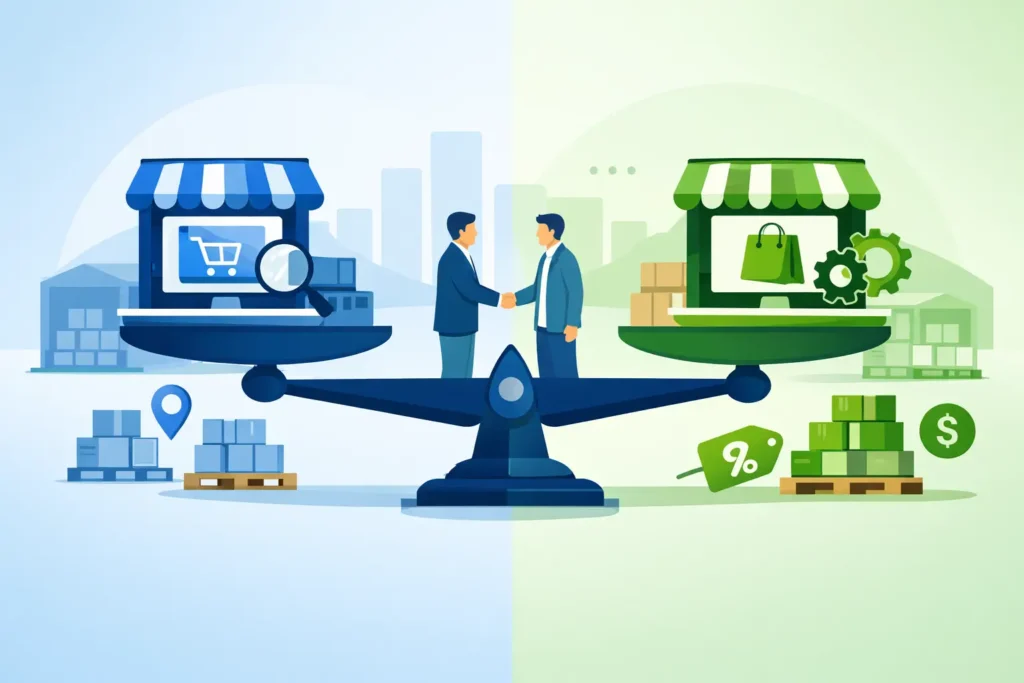
If wholesale is a serious revenue channel for your business, this decision gets expensive fast. Choosing BigCommerce or Shopify for wholesale is not just about which dashboard feels nicer. It affects how you price accounts, manage customer groups, handle sales rep workflows, and control the amount of custom work you’ll need six months from now.
A lot of merchants start this comparison too late. They pick a platform based on retail features, then try to force wholesale into the gaps with apps, workarounds, and manual processes. That usually leads to one of two outcomes: operational drag or a rebuild.
For wholesale, the better platform is the one that fits your catalog structure, account model, pricing logic, and internal team. Not the one with the loudest marketing.
BigCommerce or Shopify for wholesale: the real decision
The cleanest way to evaluate this is to ignore surface-level feature lists and look at how each platform handles B2B complexity.
If your wholesale operation is fairly simple, both platforms can work. If you need gated pricing, customer-specific catalogs, account hierarchies, quote workflows, tax handling, purchase orders, or ERP-heavy operations, the gap gets wider.
BigCommerce has made a strong case for wholesale because it supports B2B functionality in a way that feels closer to native commerce architecture than patched-together retail logic. Shopify can support wholesale too, but the path often depends more heavily on plan level, apps, customizations, or Shopify Plus-specific features.
That distinction matters. Wholesale businesses do not need more moving parts than necessary.
Where BigCommerce tends to win for wholesale
BigCommerce is often the better fit when wholesale is not a side project, but a core business model. Its approach tends to give merchants more control over how B2B customers are segmented, what they can see, and how pricing rules are applied.
With BigCommerce B2B Edition, merchants can support company accounts, buyer roles, shared company-level purchasing, quote requests, invoice payment options, and sales rep workflows. Those are not fringe needs in wholesale. They are normal operating requirements.
Another advantage is flexibility. BigCommerce generally gives merchants and developers more freedom at the storefront and checkout level without forcing an enterprise upgrade just to gain practical control. That matters if your wholesale store needs custom account experiences, ERP integrations, or workflow-specific logic.
Catalog complexity is another area where BigCommerce often feels more comfortable. If you have large product sets, variant-heavy products, negotiated pricing, or a mix of retail and wholesale experiences in one ecosystem, BigCommerce tends to hold up well.
This does not mean it is automatically easier. It means the platform is often better aligned with how wholesale businesses actually operate.
Where Shopify can make sense for wholesale
Shopify earns its reputation for a reason. It is fast to launch, user-friendly, and has a large app ecosystem. For brands that started in DTC and want to add a lighter wholesale channel, Shopify can be a reasonable option.
If your needs are straightforward, such as offering a private wholesale portal, basic customer tagging, separate pricing, and a simple ordering flow, Shopify may get you there quickly. Teams that already know Shopify also value the familiarity.
But the question is not whether Shopify can do wholesale. It can. The question is how much effort, cost, and platform stacking it will take to support your version of wholesale.
That is where some merchants run into trouble. On standard Shopify plans, wholesale often relies on third-party apps to create the account logic and pricing structure that B2B sellers need. On Shopify Plus, the wholesale picture improves significantly, but so does the price.
For some businesses, that trade-off is fine. For others, it means paying enterprise-level costs to get features that should have been part of the decision from day one.
Pricing and total cost are not the same thing
Merchants often compare monthly subscription pricing and stop there. That is not how wholesale platforms should be evaluated.
A lower monthly platform fee means very little if your team spends hours each week correcting order data, managing customer-specific pricing manually, or juggling multiple apps that do not fully agree with each other.
BigCommerce can be more cost-effective for wholesale when the needed B2B functionality is closer to native and the build requires fewer compensating tools. Shopify can look simpler at first, but wholesale merchants should price the full operating model, including apps, custom development, support overhead, and future rework.
This is especially important for merchants with growth plans. A setup that works for 20 wholesale accounts may not hold up for 200.
BigCommerce or Shopify for wholesale catalogs and pricing
Wholesale pricing is where platform limitations become obvious fast.
If you need tiered pricing, customer group pricing, account-specific price lists, minimum order rules, or restricted product visibility, BigCommerce generally offers a more natural path. It is better suited to merchants who need different buyers to see different products or pay different prices without turning the store into a maze.
Shopify can support many of these scenarios too, but often with more dependency on apps, custom logic, or higher-tier features. That is manageable for some stores. It becomes fragile when pricing logic gets deep.
And wholesale pricing logic usually gets deep. A merchant may start with one discount tier and end up needing territory-based pricing, customer-specific terms, approved product assortments, and parent-child account controls. Wholesale rarely gets simpler over time.
Operations matter more than theme polish
One mistake merchants make is overweighting storefront aesthetics in a wholesale platform decision. Design matters, but operations matter more.
A wholesale buyer does not care that your portal has subtle hover effects if they cannot reorder efficiently, see the right net terms, access the correct catalog, or submit a quote without calling your team.
BigCommerce tends to appeal to operators because it can support more structured wholesale workflows without as much duct tape. Shopify tends to appeal to brands that prioritize speed, familiarity, and a broad ecosystem, especially when wholesale needs are still relatively light.
That does not make one platform universally better. It means you should decide based on operational fit, not visual preference.
When BigCommerce is usually the stronger choice
BigCommerce is often the stronger choice if wholesale is central to your business, if you need advanced pricing and account structures, or if your back-office systems already require tighter integration discipline.
It is also a strong option for merchants who are tired of app sprawl and want a more controlled build. That matters because every extra dependency creates another point of failure, another renewal, and another support conversation.
This is one reason merchants working with a BigCommerce expert often move faster than they expected. The platform can support serious B2B requirements, and the work stays focused on the business logic instead of endless patching.
When Shopify is usually the better fit
Shopify is often the better fit if your wholesale channel is relatively simple, your team already runs on Shopify, or your business is still testing B2B demand before investing in a more structured setup.
It can also be the right move if DTC is still your main engine and wholesale is a smaller extension of that business. In those cases, keeping everything inside a platform your team already understands may be worth the compromises.
Just be honest about those compromises. If your roadmap includes complex account management, custom pricing logic, or heavy operational controls, you should assess whether Shopify is the right long-term platform or just the fastest short-term one.
The better question to ask
Instead of asking which platform is better in general, ask which platform fits the way your wholesale business actually sells.
Do your buyers need company accounts with multiple users? Do you need approval workflows? Are sales reps placing orders on behalf of accounts? Do customers require negotiated pricing, credit terms, or invoice payments? Will your product visibility differ by account type or region? Are you trying to run both retail and wholesale without maintaining two disconnected systems?
If the answer to several of those is yes, BigCommerce deserves a very close look.
For merchants who want a direct answer, here it is: BigCommerce is usually the stronger platform for established or growing wholesale operations with real complexity. Shopify can work well for simpler B2B setups or DTC-first brands adding a lighter wholesale layer. The wrong choice is the one that forces your team into workarounds from the start.
A platform should reduce operational friction, not become its own department. If wholesale matters to your business, choose the system that will still make sense after your next hundred accounts, not just your next launch.
Sales in a slump?
Get instant access to the Conversion Boosting Self-Audit, proven to identify order-blocking issues on your website.
Plus, you'll get periodic tips, tools and exclusive offers designed to help grow your e-commerce business. Unsubscribe any time.
