
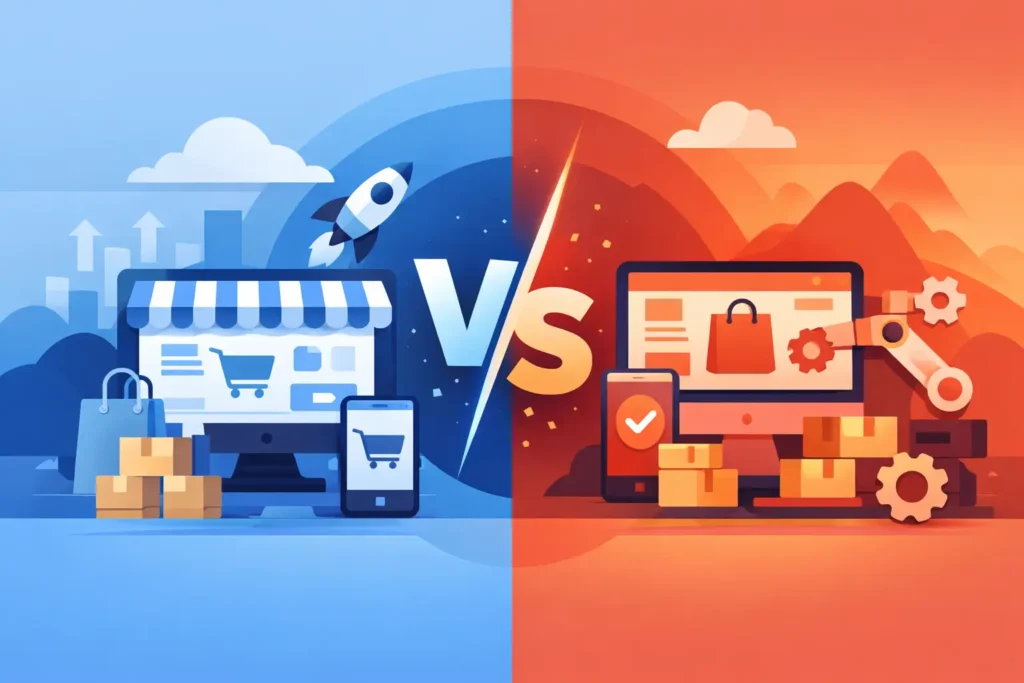
A platform decision can quietly shape every part of your operation: how quickly your team can launch promotions, how much it costs to make a change, and whether your store becomes easier or harder to manage as sales grow. In the BigCommerce versus Adobe Commerce decision, the right answer is not about which platform has the longer feature list. It is about choosing the level of control, technical ownership, and ongoing cost your business can realistically support.
BigCommerce and Adobe Commerce can both serve serious merchants. Both support complex catalogs, multiple customer groups, international selling, integrations, and custom storefront experiences. The difference is in how they get there. BigCommerce gives merchants a SaaS foundation with much of the platform infrastructure handled for them. Adobe Commerce gives merchants deeper flexibility, but that flexibility comes with a larger technical commitment.
BigCommerce Versus Adobe Commerce Comes Down to Ownership
The cleanest way to compare these platforms is to ask a practical question: who will own the work after launch?
With BigCommerce, the core platform is managed. Hosting, security updates, PCI compliance responsibilities at the platform level, and core software updates are handled by BigCommerce. Your team still needs to manage products, content, promotions, integrations, and any custom development, but you are not responsible for maintaining the commerce engine itself.
Adobe Commerce, formerly Magento Commerce, is built for businesses that want much more control over the underlying application and have the technical resources to support it. Depending on the deployment and implementation, that can mean managing hosting, upgrades, security patches, code compatibility, extensions, and performance tuning. Adobe Commerce Cloud changes some of the infrastructure equation, but it does not remove the need for experienced development oversight.
That distinction affects more than an IT checklist. It affects your budget, launch timeline, vendor relationships, and ability to make routine changes without opening a development ticket.
For a merchant that wants to focus on merchandising and growth, BigCommerce often creates a more manageable operating model. For a company with a complex technical environment, a dedicated development team, and requirements that demand substantial platform-level customization, Adobe Commerce may justify the additional responsibility.
Where BigCommerce Makes Business Sense
BigCommerce is a strong fit for merchants who need enterprise-capable commerce without treating their e-commerce platform like a custom software product.
The platform supports large catalogs, customer groups, multi-storefront selling, API-driven integrations, B2B capabilities, and headless storefronts. Those are not lightweight features. The key advantage is that merchants can use them without taking on the same level of platform maintenance that Adobe Commerce typically requires.
This matters when a marketing manager needs a category update made this afternoon, when operations needs a new shipping rule, or when a growing brand cannot afford to delay revenue-generating work while a development team works through an upgrade. BigCommerce does not eliminate the need for expert help, especially for custom themes, integrations, or B2B workflows. It does reduce the amount of technical housekeeping that sits between a business decision and execution.
BigCommerce is particularly practical when your priorities include faster implementation, predictable platform operations, and fewer moving parts. It can also be a sensible migration path for merchants leaving a heavily customized platform that has become expensive to maintain.
That said, SaaS does impose guardrails. If your business requires deep changes to core checkout behavior, data models, or platform logic, you need to verify that BigCommerce can support the requirement through native functionality, APIs, an app, or a targeted custom solution. Do that work before signing a contract, not after your catalog has been imported.
Where Adobe Commerce Earns Its Complexity
Adobe Commerce is not the wrong choice because it is more demanding. It is the right choice for some businesses precisely because it can be shaped around highly specific requirements.
Its strength is depth. A company with unusual product configuration rules, intricate pricing logic, custom account workflows, or a tightly connected Adobe ecosystem may find more room to build exactly what it needs. It has a long history in complex B2B and enterprise commerce environments, and its extensibility remains a major reason merchants consider it.
The trade-off is that every extension, customization, and integration creates an ongoing ownership question. Who will test compatibility when the platform is updated? Who will monitor performance during a major campaign? Who will fix a checkout issue when a third-party module conflicts with custom code? Those responsibilities do not disappear after launch.
Adobe Commerce works best when the business has a clear technical governance model. That may be an in-house engineering team, a retained development partner, or both. What does not work well is treating Adobe Commerce as a set-it-and-forget-it platform and discovering later that routine maintenance is consuming time and budget.
Cost Is More Than Platform Fees
Merchants often compare licensing or subscription costs first. That is understandable, but it is incomplete.
A realistic comparison includes implementation, hosting, security, support, development, third-party extensions, upgrades, and the internal time required to manage vendors. A lower initial project estimate can become irrelevant if ongoing maintenance expands year after year.
BigCommerce usually offers a clearer operational cost structure because the SaaS platform includes core hosting and managed updates. You still need to budget for design, development, apps, ERP or PIM connections, and ongoing optimization. But the baseline is generally easier to forecast.
Adobe Commerce can require a more substantial upfront investment and a larger ongoing technical budget. The return can be worthwhile if its custom capabilities directly support a high-value business model. For example, a manufacturer with deeply specialized ordering processes may gain more from a tailored Adobe implementation than it spends maintaining it. But if the custom work exists only because no one simplified the process first, the platform can amplify an operational problem rather than solve it.
Do not choose Adobe Commerce because it feels more enterprise. Do not choose BigCommerce because it appears easier. Choose the platform whose total cost matches the commercial value of the complexity you need.
B2B: Compare the Workflow, Not the Label
Both platforms are used for B2B commerce, but “B2B” is too broad to be useful on its own.
Start with the actual buying experience your customers need. Can buyers log in to see contract pricing? Do they need company accounts with multiple users and approval roles? Are they placing repeat orders from saved lists? Do sales representatives need to place orders on behalf of customers? Is quoting central to the sale, or is it an exception process?
BigCommerce offers meaningful B2B functionality and can be an excellent fit for wholesalers, distributors, and brands that need customer-specific pricing and account management without building an entire custom portal. It is especially appealing when the goal is to give business buyers a clean self-service ordering experience while keeping administration manageable for the merchant.
Adobe Commerce can support highly tailored B2B workflows, particularly where requirements extend beyond standard account structures and pricing rules. The question is whether those workflows are truly differentiating or simply inherited from a manual process that should be reconsidered.
Before selecting either platform, map your top five B2B tasks from the buyer’s perspective and the administrator’s perspective. A platform demo can make any feature look polished. Your real test is whether it handles your exceptions, integrations, and internal approval process without creating more work.
Implementation Speed and Day-Two Reality
A BigCommerce launch can move quickly when the scope is controlled. That does not mean cutting corners. It means making decisions early about catalog structure, shipping, payments, customer data, redirects, content, and the integrations required on day one.
Adobe Commerce projects generally need more time for architecture, development, testing, and deployment planning. That timeline may be appropriate for a complex build, but it needs to be planned honestly. A platform cannot compensate for unclear requirements, incomplete data, or a decision-maker who is unavailable when approvals are needed.
The bigger difference appears after launch. BigCommerce merchants can usually make more routine storefront and merchandising changes without involving a full development team. Adobe Commerce merchants may have more room to customize, but should expect a closer relationship with technical resources for changes, patches, and quality assurance.
For many brands, day-two reality is the deciding factor. Your store will need ongoing attention long after the launch celebration ends. The best platform is the one your team can operate confidently without letting small improvements sit in a backlog for months.
How to Make the Right Call
Choose BigCommerce when you want a capable, scalable commerce platform with managed infrastructure, predictable operations, and room for customization where it matters. It is a strong choice for brands that want to move quickly without carrying the full burden of platform maintenance.
Choose Adobe Commerce when your requirements demand substantial control over the commerce application itself and you have the budget, development support, and operational discipline to maintain it. Its flexibility is valuable when it solves a genuine business requirement, not when it simply enables more complexity.
If you are leaning toward BigCommerce but need a clear view of migration scope, theme requirements, integrations, or B2B setup, a BigCommerce expert can help separate must-haves from expensive assumptions. Duck Soup E-Commerce works exclusively in BigCommerce, which keeps that conversation focused on what the platform can actually do and what it will take to do it well.
A commerce platform should give your business more control, not create another system your team is afraid to touch. Make the decision based on the work you need done every week, not just the features that look impressive in a sales demo.
Sales in a slump?
Get instant access to the Conversion Boosting Self-Audit, proven to identify order-blocking issues on your website.
Plus, you'll get periodic tips, tools and exclusive offers designed to help grow your e-commerce business. Unsubscribe any time.
