

A lot of BigCommerce stores do not have a traffic problem. They have a decision problem. Shoppers land, browse, hesitate, and leave because the store is asking them to work too hard. If you want to know how to improve BigCommerce conversion, start there. Better conversion usually comes from reducing friction, clarifying value, and making the next step obvious.
That sounds simple, but most conversion issues are not caused by one dramatic mistake. They come from small breakdowns across the storefront – slow category pages, weak product messaging, confusing filters, clumsy mobile layouts, or a checkout flow that introduces doubt at the worst possible moment. The good news is that BigCommerce gives merchants a strong foundation. The challenge is using it with discipline.
How to improve BigCommerce conversion without guessing
The fastest way to waste time is to chase random best practices. A high-converting apparel store does not behave like a B2B parts catalog. A high-AOV brand may need more education before purchase, while a replenishment brand may need speed above all else. Conversion work only pays off when it matches how your customers actually buy.
Start by looking at where buyers stall. If product page traffic is healthy but add-to-cart is weak, your issue is usually offer clarity, product trust, or merchandising. If carts are full but checkout completion is poor, the friction is later in the funnel. If mobile traffic is high and revenue lags desktop by a wide margin, your mobile experience likely needs attention before anything else.
This is where merchants often get burned by broad agency advice. Generic recommendations sound polished, but they do not tell you what to fix first. Good conversion work is ordered. It starts with the bottleneck that affects the most revenue.
Fix the storefront friction that costs sales first
Your homepage matters, but it is rarely the main conversion lever. Most buyers enter through category pages, product pages, search, shopping ads, email, or branded campaigns. The stores that convert well keep those entry points clear and efficient.
Category pages need to help people narrow options fast. If filters are missing, buried, or inaccurate, shoppers bounce. If product cards do not communicate enough information, users are forced into extra clicks. On BigCommerce, even small merchandising improvements can have an outsized effect here – stronger thumbnail strategy, clearer pricing display, visible product attributes, and better sorting logic all reduce effort.
Site search deserves the same scrutiny. If people search and get thin results, irrelevant matches, or no useful fallback paths, they leave with high intent and low patience. Search behavior is one of the cleanest signals of purchase intent, so if your store search experience is weak, that is usually low-hanging revenue.
Mobile deserves its own review, not a quick responsive check. A design can technically work on mobile and still convert badly. Look for oversized banners pushing products too far down the page, sticky elements blocking content, variant selectors that are awkward on touchscreens, and add-to-cart buttons that require extra scrolling. Mobile conversion improves when the path feels shorter, not when the store simply shrinks to fit a smaller screen.
Product pages are where BigCommerce conversion is won or lost
For many merchants, the product page is the real sales page. That means it has to answer questions in the order buyers actually ask them.
First, can the shopper understand the product quickly? The product title, imagery, price, availability, and core value should be obvious within seconds. If a buyer has to hunt for basic facts, you are already creating drag.
Second, can they trust what they are seeing? This is where many stores underperform. Thin descriptions, weak imagery, vague shipping information, and missing return details create uncertainty. Conversion drops when customers feel they are filling in blanks themselves. Strong product pages remove that mental work with useful images, practical copy, size or spec clarity, and visible policies.
Third, can they make a decision without interruption? Variant selection is a common failure point. When size, color, configuration, or pack options are hard to understand, conversion suffers. For some stores, swatches and visual selectors help. For others, plain language and better inventory messaging matter more. It depends on the product, but the principle is the same: decision-making should feel easy.
Social proof also matters, but only when it supports the buying decision. Reviews can help, especially for consumer products, but they are not magic. A B2B buyer may care more about specifications, lead times, and compatibility than star ratings. Do not force every product into the same conversion playbook.
Improve checkout by removing doubt, not just clicks
Merchants love to talk about cart abandonment as if it is a checkout design issue alone. Often it is not. People abandon because total cost surprises them, because delivery timing is unclear, because they are not ready to commit, or because the site has not earned enough trust yet.
That said, checkout still needs to be clean. On BigCommerce, you want as little interruption as possible between cart and payment. Unexpected fields, distracting coupon boxes, unclear shipping methods, and payment limitations can all hurt completion rates.
A few details carry more weight than merchants expect. Showing estimated delivery timing can reduce hesitation. Making guest checkout easy matters for first-time buyers. Offering the payment methods your audience expects matters too. A premium consumer brand may benefit from financing or accelerated wallets, while a B2B store may need purchase-order workflows or clearer tax handling. The right setup depends on your customer mix.
Cart pages also deserve more attention. If the cart feels like a dead end, buyers drift. If it reinforces value with clear totals, shipping expectations, and a smooth next step, it does its job. This is not about stuffing the cart with upsells. It is about keeping momentum.
Merchandising and messaging have to work together
A surprising number of stores treat conversion like a design problem when it is really a communication problem. A polished theme will not fix weak product positioning.
If your store sells on quality, show why the quality is worth paying for. If your advantage is speed, put fulfillment and delivery confidence front and center. If your catalog is complex, simplify how products are grouped and explained. Buyers do not convert because a page looks modern. They convert because the offer feels clear and credible.
This is especially true for stores with broad catalogs. When everything is presented with the same visual weight, nothing stands out. Good merchandising gives structure to choice. Bestsellers, bundles, comparison cues, recently viewed products, and logical cross-sells can all help, but only if they support the buying process rather than clutter it.
Use data, but keep your standards high
The best answer to how to improve BigCommerce conversion is usually not a dramatic redesign. It is a tighter operating standard.
Review heatmaps, session recordings, analytics, on-site search terms, and checkout drop-off points, but do not treat every metric as equally useful. A small sample can mislead you. A loud internal opinion can send you in the wrong direction. Pattern recognition matters more than isolated anecdotes.
Testing is valuable, but so is expert judgment. Not every store needs formal A/B testing software before making obvious fixes. If your product pages bury shipping info, if your mobile add-to-cart button is hard to reach, or if your category pages make filtering painful, you do not need months of experimentation to act. Clean up the friction first. Then test the finer points.
This is where specialized BigCommerce experience becomes practical, not theoretical. A merchant does not just need ideas. They need to know which fixes are straightforward inside the platform, which require theme or checkout customization, and which changes will create maintenance headaches later. That is often the difference between a nice recommendation and a real improvement.
How to improve BigCommerce conversion in the right order
If you are trying to prioritize, start with the highest-impact pages and the clearest friction. Look at mobile first if mobile traffic dominates. Look at product pages first if traffic is healthy but revenue lags. Look at checkout first if carts are strong but purchases stall. Work in sequence.
The disciplined approach is usually the profitable one. Fix the parts of the store that make customers hesitate. Tighten the message. Clarify the offer. Reduce the number of moments where a buyer has to stop and figure something out.
For merchants who are tired of vague advice and slow agency cycles, that kind of focused conversion work is usually where the real gains show up. Not in flashy presentations. In cleaner decisions, fewer leaks, and a store that does a better job of selling.
A better-converting BigCommerce store does not need to feel clever. It needs to feel easy to buy from.
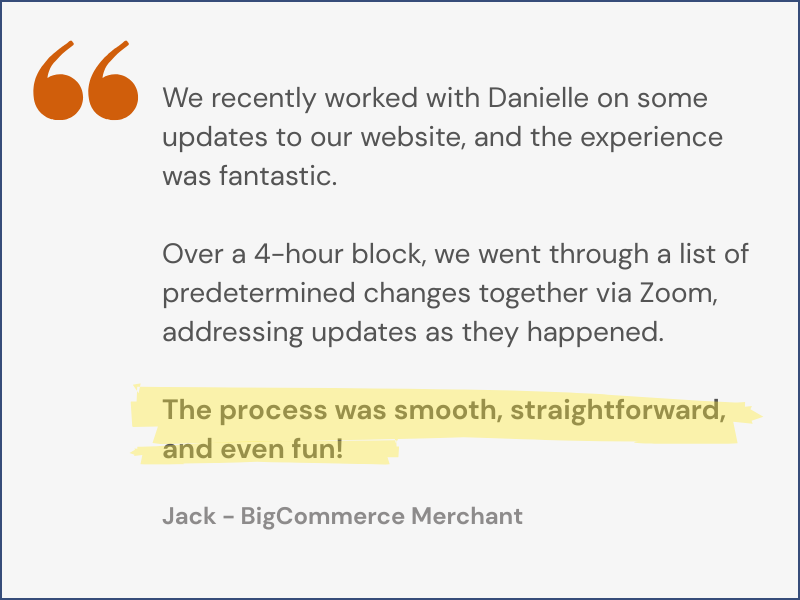
Looking for a quick and strategic way to improve conversion in your store? My Power Block sessions are ideal for reviewing problem areas, identifying solutions, and implementing quick fixes.
Sales in a slump?
Get instant access to the Conversion Boosting Self-Audit, proven to identify order-blocking issues on your website.
Plus, you'll get periodic tips, tools and exclusive offers designed to help grow your e-commerce business. Unsubscribe any time.
