

If you’ve ever had to repeat the same BigCommerce issue to a sales rep, then an account manager, then a project manager, then a developer who still missed the point, you already understand why direct BigCommerce project communication matters. The problem is not just annoyance. It is wasted budget, slower execution, muddled priorities, and fixes that do not line up with how your store actually runs.
For merchants, communication is not a soft issue. It is part of delivery. If the person hearing your goals is not the person doing the work, details get flattened fast. A catalog quirk becomes a generic ticket. A checkout concern turns into a delayed estimate. A migration risk gets noticed too late because the person making technical decisions was three conversations removed from the original context.
What direct BigCommerce project communication actually changes
In a traditional agency setup, communication is often split across roles. One person gathers requirements. Another scopes the project. Someone else manages timelines. A developer picks up tasks from a board. Each person may be competent, but every handoff creates room for interpretation.
That structure can work on large, layered engagements. It can also create drag that merchants feel almost immediately. Questions take longer to answer because someone has to check with someone else. Technical trade-offs are filtered through people who are not building the store. Scope becomes less precise because the original business context gets diluted.
Direct BigCommerce project communication removes that chain. The merchant speaks to the person who is actually evaluating the work, making implementation decisions, and accountable for the outcome. That means fewer assumptions, faster clarification, and less translation between business needs and technical execution.
This is especially important on BigCommerce because many projects are not purely design or purely development. They sit in the messy middle. Theme limitations affect merchandising. Product data affects navigation. app choices affect customer experience, operations, and long-term maintainability. The person advising you needs to understand the platform in practice, not just in theory.
Why merchants lose time in layered agency communication
The biggest hidden cost in agency work is often not the hourly rate. It is delay. Delay in diagnosing the real issue. Delay in getting a straight answer. Delay in moving from discussion to action.
When communication is fragmented, simple tasks get stretched. A merchant asks whether a feature should be custom built or handled with native BigCommerce functionality. Instead of getting a direct answer, the question gets routed. The response comes back later, often stripped of nuance, and may still require another meeting.
That pattern repeats across the project. Homepage revisions. Category page behavior. shipping settings. B2B requirements. ERP considerations. Customer group logic. None of these are impossible problems. They just become expensive when every decision needs a game of telephone.
Direct communication tightens that loop. You ask the question. The person with platform knowledge answers it. If there is a trade-off, you hear the trade-off clearly. If there is risk, it gets called out early. If your request is not the best use of time or budget, you can be told that directly instead of being sold a padded process.
Direct BigCommerce project communication improves scope quality
Most e-commerce projects do not fail because merchants ask for too much. They fail because scope starts out fuzzy and stays fuzzy.
A BigCommerce redesign may sound straightforward until product filtering, faceted search behavior, custom fields, third-party reviews, and mobile navigation all collide. A migration may seem like a data transfer job until SEO structure, redirects, option sets, and customer records need careful handling. A launch may look close to done until taxes, shipping rules, transactional emails, and payment edge cases surface.
Good scope comes from direct conversations with someone who knows what questions to ask. Not generic intake questions. Real questions shaped by BigCommerce experience. How are products currently organized? Are there category-level display exceptions? Do you need custom templates or better use of theme settings? What back-office process will this change affect?
That is where direct communication pays off. It helps define the work before the work starts. Merchants get clearer expectations, fewer vague line items, and less chance of hearing, halfway through the project, that a key requirement was never actually included.
Why senior-level access matters on BigCommerce projects
Not every task requires a strategy session. Sometimes you just need a banner update, a stencil theme tweak, or help sorting out settings. But even smaller requests benefit when the person handling them understands the larger business and platform context.
Senior-level direct communication matters because BigCommerce decisions are rarely isolated. A quick customization can affect theme performance. A checkout workaround can create future maintenance issues. A short-term app install can become long-term subscription overhead.
An experienced specialist can usually spot these downstream effects before they become your problem. That does not mean every answer is complicated. Often the best answer is simpler. Use native functionality. Skip the custom build. Phase the work. Fix the underlying data issue first.
That kind of advice is hard to get when your main point of contact is managing communication rather than making technical decisions. It is much easier to get when the same person owns the recommendation and the execution.
Direct BigCommerce project communication and accountability
Merchants want clarity because clarity makes it easier to hold someone accountable. When too many people touch a project, responsibility gets blurry. The timeline slips because development was waiting on approval. Approval was waiting on revised scope. Scope was waiting on technical review. Nobody is exactly wrong, but nothing moves.
With direct communication, ownership is easier to see. The person discussing priorities is the same person doing the work or deciding how it gets done. That creates a stronger feedback loop. Progress is more visible. Blockers are identified earlier. Decisions happen with context instead of committee lag.
This is one reason many merchants prefer a specialist model over a full agency team, especially for BigCommerce-specific work. They are not looking for more layers. They are looking for fewer surprises.
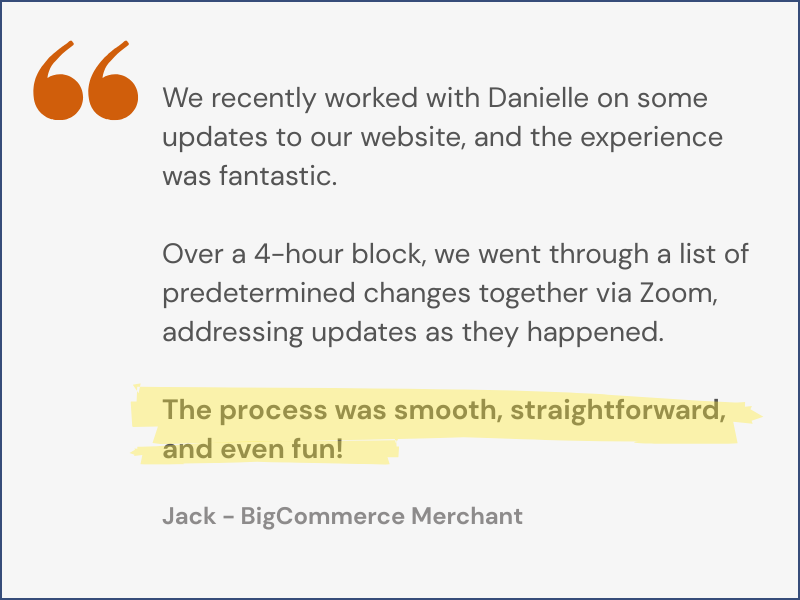
Duck Soup E-Commerce is built around that principle. The value is not just BigCommerce expertise. It is direct senior-level execution with no account-manager buffer and no junior handoff halfway through the job. Learn about the Power Block method >
When direct communication is not the perfect fit
There are trade-offs, and they should be said plainly.
If a company needs round-the-clock coverage across multiple departments, a larger agency or internal team may make sense. If a project involves broad brand strategy, paid media, custom integrations, and heavy creative production all at once, a solo specialist model may not cover every lane.
But for merchants who need focused BigCommerce execution, platform-specific guidance, and a cleaner path from question to action, direct communication is often the better fit. It reduces overhead. It keeps decisions close to the work. It gives merchants access to the person who can actually solve the problem.
The key is matching the structure to the job. More people does not automatically mean better process. Sometimes it means more meetings, more interpretation, and more room for mistakes.
How to tell if your current setup has a communication problem
You usually do not need a formal audit to spot it. The signs show up in everyday project friction.
If you are repeating requirements multiple times, waiting days for basic answers, or getting recommendations that do not reflect how your store really operates, communication is already hurting delivery. The same is true if estimates feel vague, revisions keep circling, or technical decisions seem disconnected from merchandising and operations.
A healthy BigCommerce engagement should feel controlled. Not slow for the sake of process. Not chaotic in the name of flexibility. Controlled means you know what is being done, why it is being done, what it affects, and what comes next.
That is the practical advantage of direct BigCommerce project communication. It is not about being informal. It is about reducing noise so the right work gets done faster and with fewer misses.
Merchants do not need more layers between the problem and the person fixing it. They need cleaner conversations, sharper scope, and accountability that is easy to see. If your current project structure keeps turning simple decisions into long loops, the communication model is not a side issue. It is the issue.
The right BigCommerce partner should make the work feel clearer with every conversation, not more crowded.
Sales in a slump?
Get instant access to the Conversion Boosting Self-Audit, proven to identify order-blocking issues on your website.
Plus, you'll get periodic tips, tools and exclusive offers designed to help grow your e-commerce business. Unsubscribe any time.
